
VIP member
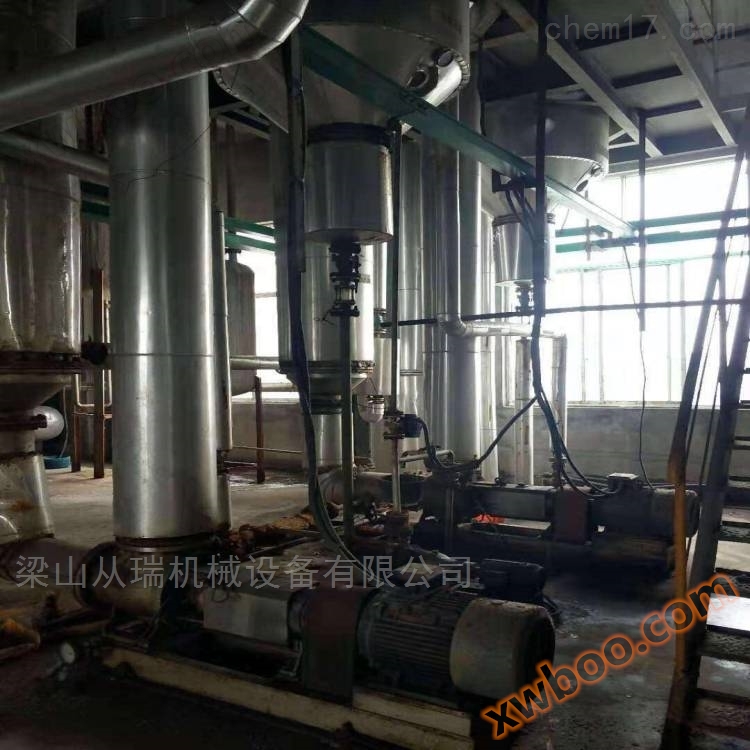
Supply second-hand double effect evaporators
Components of evaporation device/supply of second-hand double effect evaporator 1 In most cases, preheaters and heaters require the products to be eva
Product details
Components of evaporation device/Supply second-hand double effect evaporators
1. Preheaters and heaters
In most cases, the product to be evaporated must be preheated to boiling point before entering the heating chamber. Usually, straight tube preheaters or plate heat exchangers are used to complete this task.
2. Evaporator
Choosing the appropriate type of evaporator depends on each specific application and the nature of the product.
3. Separators
Each evaporator is equipped with a separator for separating steam and liquid. Select different types of separators according to their application scope, such as centrifugal separators, gravity separators, or separators with internal components.
condenser
In possible situations, the steam heat generated during the evaporation process is used to heat downstream evaporators and preheaters, or to compress the steam as a heating medium. However, the residual steam after the evaporation device cannot be utilized in this way and must be condensed. Evaporation devices can be equipped with surface condensers, contact condensers, or air-cooled condensers.
5. Degassing/Vacuum System
Use a vacuum pump to maintain the vacuum in the evaporation device. They discharge leaked air and non condensable gases from the device, as well as dissolved gases brought in during liquid feeding. For this purpose, corresponding jet pumps and liquid ring pumps can be used according to the scale and operation mode of the evaporation device.
6. Pump
Due to the complexity of design conditions and applications, pump selection must be considered. The selection criteria are the product characteristics, suction head condition, flow rate, and compression ratio in the evaporation device. For low viscosity products, centrifugal pumps are mainly used; High viscosity products require the use of a volumetric pump. Some products containing solids or crystals use other types of pumps, such as propeller pumps. Determine the type, size, speed, mechanical seal, and material of the pump based on specific application scenarios and related usage conditions.
Basic principles/Supply second-hand double effect evaporators
MVR evaporator is the abbreviation for mechanical vapor recovery in English. MVR is a technology that reuses the energy generated by its own secondary steam to reduce the demand for external energy.
The secondary steam, after being compressed by the compressor, increases in pressure and temperature, and increases in enthalpy. It is sent to the heating chamber of the evaporator as heating steam, which is used to maintain the evaporation state of the material liquid. The heating steam itself transfers heat to the material and condenses into water. In this way, the steam that was originally intended to be discarded is fully utilized, latent heat is recovered, and thermal efficiency is improved.
As early as the 1960s, Germany and France had successfully applied this technology to industries such as chemical, pharmaceutical, papermaking, sewage treatment, and seawater desalination.
The working process involves the compression of low-temperature steam by a compressor, which increases the temperature and pressure, increases the enthalpy, and then enters a heat exchanger for condensation to fully utilize the latent heat of the steam. Except for starting the car, there is no need to generate steam during the entire evaporation process.
In the process of multi effect evaporation, the secondary steam of one effect of the evaporator cannot be directly used as the heat source of the main effect, but can only be used as the heat source of the secondary effect or several secondary effects. As a heat source for this effect, additional energy must be provided to increase its temperature (pressure). The steam jet pump can only compress a portion of the secondary steam, while the MVR evaporator can compress all the secondary steam in the evaporator.
Online inquiry
-
Contacts
-
Company
-
Telephone
-
Email
-
WeChat
-
Verification Code
-
Message Content
-